Arusha National Park is Tanzania’s most accessible and most underrated wildlife destination. Located just 90 minutes from Moshi and 30 minutes from Arusha, it is the perfect day trip for travellers who want a genuine Tanzania wildlife experience without the multi-day commitment of the Serengeti or Ngorongoro. Within its compact 552 km², Arusha National Park encompasses forest, savannah, volcanic craters, alkaline lakes, and the dramatic flanks of Mount Meru — Tanzania’s second-highest peak at 4,566 metres — creating a diversity of habitats and wildlife encounters that far exceeds what the park’s size would suggest.
This guide covers everything you need to know for an Arusha National Park day trip from Moshi — the wildlife highlights, the canoeing experience, entry fees, the best areas to visit, and practical preparation advice from Serac Adventure.
| Arusha National Park at a glance |
| Location: 30km east of Arusha, 90km from Moshi |
| Size: 552 km² |
| Established: 1960 (one of Tanzania’s oldest national parks) |
| Entry fee: ~$55 per adult per 24 hours |
| Vehicle fee: $40 per vehicle |
| Highlights: Mount Meru, Momella Lakes (flamingos, hippos), Ngurdoto Crater, colobus monkeys |
| Wildlife: giraffe, zebra, buffalo, warthog, colobus monkey, flamingo, hippo, reedbuck |
| Canoeing: available on Momella Lakes |
| Serac Adventure price from: $130 per person including park fees and vehicle |
Why visit Arusha National Park on a day trip from Moshi?
The park’s proximity to Moshi makes it uniquely accessible for day visitors. A 7:00am departure from Moshi allows you to reach the park gate before 9:00am, giving a full day of wildlife viewing before returning to Moshi by 5:00pm. Unlike the Serengeti or Ngorongoro — which require multi-night stays to justify the driving time — Arusha National Park rewards a single well-planned day. The park is ideal as an introductory wildlife experience before a northern circuit safari, or as a stand-alone day trip for travellers with limited time in the Moshi area.
Wildlife highlights
Giraffe, zebra, and buffalo
The open savannah sections of Arusha National Park — particularly around the Momella Lakes and the Ngurdoto Crater rim — support large populations of Masai giraffe, Burchell’s zebra, and cape buffalo. Giraffe are almost always encountered on an Arusha NP game drive and at very close range — the park’s lower vehicle traffic means animals are less habituated to constant tourist presence, creating more natural and sometimes more dramatic wildlife encounters than at busier parks.
Colobus and vervet monkeys
The montane forest sections of Arusha National Park — particularly around the Ngurdoto Crater and the forested road to Meru — support dense populations of black-and-white colobus monkeys. These dramatic primates, with their long flowing white mantles and bold colouring, are regularly encountered at close range from the vehicle and are one of the park’s most photographically rewarding species. Vervet monkeys and olive baboons are also common throughout.
Flamingos on Momella Lakes
The Momella Lakes are a series of shallow, highly alkaline volcanic crater lakes that support substantial flamingo populations. The alkalinity and algae content of the water creates ideal flamingo feeding conditions — and the sight of hundreds or thousands of flamingos turning the lake margins pink against the backdrop of Mount Meru is one of the most photographically striking scenes in northern Tanzania. The lakes also support hippos, waterfowl, and a variety of wading birds.
Mount Meru views
On clear mornings, the views of Mount Meru from within Arusha National Park are extraordinary. Tanzania’s second-highest peak is a dramatic volcanic cone whose summit crater is visible on cloudless days. The scale of Meru — 4,566 metres — is more immediately comprehensible from within the park than from Moshi, and the mountain creates a dramatic backdrop to every game drive.
Canoeing on Momella Lakes
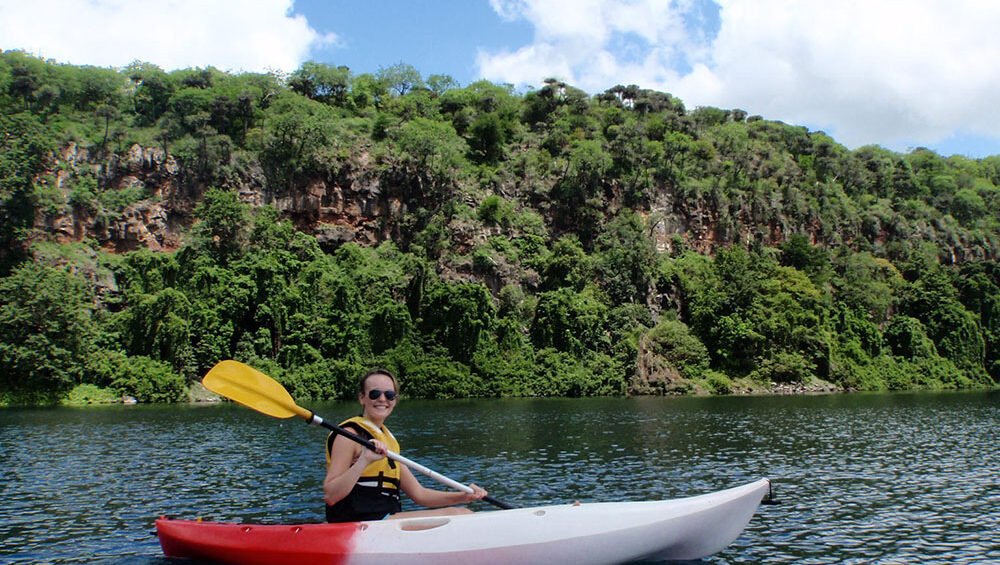
The canoe safari on Momella Lakes is one of Arusha National Park’s most distinctive experiences — and one that very few Tanzania visitors take advantage of. Two-person canoes are available from the park’s designated canoe launch area, and paddling silently across the alkaline lakes in the company of hippos, flamingos, and waterfowl is a fundamentally different sensory experience from vehicle-based game viewing.
The canoe route takes you across the lake surface at water level — eye to eye with hippos submerged to their nostrils, within metres of flamingo feeding flocks, and with the full panoramic view of Mount Meru above the far shore. Sessions last approximately 1–1.5 hours. Life jackets are provided. No canoeing experience is required.
- Cost: approximately $20 per person additional to park entry fee
- Duration: 1–1.5 hours
- Life jackets provided — no canoeing experience required
- Guide accompanies in a separate canoe
- Best time: early morning when hippos are most visible and flamingo numbers are highest
Ngurdoto Crater
Ngurdoto Crater is a collapsed volcanic caldera within Arusha National Park whose floor has never been developed for tourism — it can only be viewed from the rim. The view down into the untouched forest of the crater floor, with buffalo, warthog, and colobus visible in the vegetation below, is remarkable for its sense of genuine wilderness preservation. The crater rim road offers outstanding views and excellent birding.
Entry fees and practical information
| Fee | Amount | Notes |
| Park entry (adult) | ~$55 per 24 hours | International non-resident rate 2026 |
| Vehicle fee | $40 per vehicle | Per entry |
| Canoe hire | ~$20 per person | Per session on Momella Lakes |
| Walking safari | ~$23 per person | With armed park ranger |
All park fees are included in Serac Adventure’s Arusha National Park day trip packages. No hidden costs.
What to bring
- Binoculars — particularly useful for flamingos on the lakes and colobus in the forest canopy
- Sunscreen and sun hat — the open lake areas provide minimal shade
- Camera with telephoto lens for giraffe and flamingo photography
- Light jacket — the forested sections can be cool even in the midday heat
- Swimwear is not needed — canoeing is done fully clothed
Frequently asked questions: Arusha National Park
Is Arusha National Park worth visiting if I am doing the full northern circuit safari?
Yes — it offers wildlife and experiences (particularly canoeing) not available in the other northern circuit parks. It is an excellent pre-safari warm-up visit on the day before your northern circuit departs, or as an additional activity on the day you arrive in Moshi before the main safari begins.
Can I see the Big Five in Arusha National Park?
No — Arusha National Park does not support lion, leopard, or rhino. Elephant are occasionally present in the park periphery. Buffalo are common. The park should not be visited specifically for Big Five sightings — it excels at different species (colobus, giraffe, flamingo) and unique experiences (canoeing, Mount Meru views).
How does Arusha National Park compare to Tarangire?
They offer quite different experiences. Tarangire is a full national park with Big Five, massive elephant herds, and a richer predator population — best visited as part of a multi-day safari. Arusha National Park is ideal as a day trip, with unique features (canoeing, Ngurdoto Crater, forest primates) that Tarangire does not offer. Many travellers visit both on consecutive days.
| Book the Arusha National Park day trip with Serac Adventure Full-day private game drive including canoeing option. Hotel pickup from Moshi or Arusha. Price from $130 per person — park fees, vehicle, guide, and lunch included. Contact us: +255 785 790 460 (WhatsApp) | info@seracadventure.com |