Nothing fully prepares you for climbing Kilimanjaro. Not the YouTube videos, not the blog posts, not the training hikes. The mountain has a way of exceeding all expectations — both in its difficulty and in the profound reward of standing on the Roof of Africa at sunrise. But the more honestly you understand what is coming, the better placed you are to handle it.
This guide is written from the perspective of Serac Adventure’s guides — men who have walked the mountain hundreds of times and have watched thousands of climbers experience it for the first time. It is honest about the hard parts, honest about the beautiful parts, and honest about why so many people describe Kilimanjaro as the most significant physical undertaking of their lives.
Before the climb: arrival in Moshi
Most climbers arrive at Kilimanjaro International Airport (JRO) and transfer to Moshi — a warm, dusty, friendly town at the foot of the mountain. Kilimanjaro itself is often hidden in cloud when you arrive, the summit invisible above the horizon. You might see it briefly in the early morning before cloud builds — a snowy white cap floating impossibly high above the green lower slopes.
The day before your climb, Serac Adventure conducts a gear check and briefing at our Moshi office. Your guide goes through your equipment item by item, checks your boots are broken in, advises on last-minute additions, and talks you through what the next week holds. You meet the guide who will walk with you to the summit. That meeting matters — the relationship between climber and guide is the most important variable on the mountain.
That evening, most climbers report feeling a mix of excitement and nerves. Both are appropriate. Whatever happens on the mountain, it begins tomorrow.
Day 1: the rainforest — easier than you expected
The drive to the park gate takes about an hour from Moshi. Registration formalities, weight checks for porter bags, introductions to the full crew. Then the trail begins.
The first thing almost every climber notices is the pace. It is slower than you want to walk. Embarrassingly, almost insultingly slow. Your legs want to stride out, your fitness says you could move faster — and your guide maintains the pace regardless. This is pole pole, and it is not arbitrary. Every step saved on Day 1 is a step still available on summit night.
The rainforest is extraordinary. Moss and lichen drape from ancient trees in deep green curtains. The air is warm and humid. Colobus monkeys crash through the canopy overhead. The mountain is invisible above the forest canopy — it feels less like a high-altitude expedition and more like a walk through a jungle. Most first-time climbers arrive at the first camp in good spirits, surprised at how manageable the day felt.
Days 2–3: altitude becomes real
Above the treeline, the landscape transforms. Open heath and moorland stretch to the horizon, dominated by alien-looking giant senecio plants and lichen-covered volcanic rock. The views open dramatically — you can see for hundreds of kilometres on clear days, Mount Meru floating above the clouds to the west.
Somewhere around 3,000 metres, altitude begins to register. Not dramatically — just a slight heaviness, a mild headache that appears in the evening, an appetite that is not quite what it was. These are normal signs that your body is responding to reduced oxygen. Your guide conducts the first pulse oximeter check that evening. The number is lower than sea level and higher than the summit — a data point in an ongoing conversation about your body’s adaptation.
Sleep at altitude is often the first genuine shock. Even tired after a full day of hiking, sleep at 3,500m is fragmentary — you surface frequently in the night, breathing consciously where breathing used to be automatic. The air tastes thin. This is normal. By morning you feel better than during the night, which will become the pattern for the rest of the climb.
Day 4: Lava Tower — the hardest non-summit day
On the Lemosho and Machame routes, Day 4 involves ascending to Lava Tower at 4,630 metres. This is the day many climbers experience their most significant AMS symptoms — real headache, nausea, a heaviness in the limbs that makes even slow uphill movement feel like swimming through air. The ground at Lava Tower feels impossibly high. The summit, visible above, seems another world away.
Then you descend to Barranco Camp. And within the hour, you feel remarkably better. The headache lifts. Appetite returns. This physiological experience — the dramatic improvement that comes with even a modest descent — is one of the mountain’s great revelations. Your body is telling you clearly and directly how altitude affects it, and how powerful the simple act of losing elevation is as medicine. Your guide smiles. This is exactly what is supposed to happen.
Day 5: the Barranco Wall — the most fun day
Morning begins with the Barranco Wall looming directly above camp. In photographs it looks terrifying — a 257-metre rock face that appears nearly vertical. In reality it is a scramble: hands and feet, three points of contact, a clear marked path. Your guide goes ahead, turns back to offer a hand at the key moves. The queue of climbers moves slowly but steadily upward.
Most climbers find the Barranco Wall the best day on the mountain. There is something about using your hands, about the physical engagement of scrambling rather than just walking, that lifts the mood and shifts the mindset from endurance to adventure. The views from the top of the Wall — across Kilimanjaro’s southern face, down into the Barranco Valley below, up to the glaciers above — are among the finest on the entire climb.
Days 5–6: approaching the summit zone
Above the Barranco Wall, the southern circuit crosses a landscape of increasing austerity. The vegetation thins and then disappears entirely. The colours fade from the greens and browns of the lower zones to grey and white and ochre. The air is noticeably thinner. Steps that would be effortless at sea level require conscious attention.
At Barafu Camp — the launching pad for summit night at 4,673m — the mountain reveals itself fully. The glaciers above are visible in the thinning air. The summit seems almost achievable — and yet the distances at altitude are deceptive. What looks like a few hours of walking will take seven.
The afternoon at Barafu is spent resting, eating, checking gear, and sleeping. The mountain crew brings tea and food. The mood is a combination of quiet determination and barely suppressed nerves. Your guide delivers the summit night briefing: departure time (usually midnight or 1am), what to wear, what to carry, what to do if you feel AMS symptoms worsening. Then it is time to try to sleep.
Summit night: the defining experience
The alarm sounds at 11pm. Hot tea arrives in the tent. You dress in every layer you own — thermal base, fleece, down jacket, waterproof shell, balaclava, mittens. Every item on the packing list has been building to this moment. You step outside into darkness and cold that hits like stepping into a freezer.
The headlamps create a line of light stretching up the mountain — dozens of climbers on dozens of teams, all moving in the same direction, at the same impossibly slow pace, in complete silence broken only by the crunch of boots on volcanic scree. There is something medieval and ceremonial about it. A pilgrimage in the dark.
The first two hours are manageable. Cold but manageable. The third hour is harder. The fourth is when the mountain takes everything. Each step requires concentration. The thin air means the effort of walking uphill feels like the effort of sprinting at sea level — but you are moving at a fraction of the speed. Nausea is common. Headaches are near-universal. People stop, breathe, continue.
Your guide is immediately behind you or beside you. Every 45–60 minutes there is a rest — just a few minutes, drinking water, eating a small snack, not sitting down (getting up again is too hard). Your guide checks in quietly. How is your head? How is your breathing? The conversation is minimal but the attention is constant.
| Summit night hour by hour (approximate) |
| Midnight: Depart Barafu Camp (4,673m). Cold, dark, headlamps on. |
| 1am–2am: Steep scree switchbacks above camp. Physical demand builds. |
| 2am–3am: The hardest zone. Thin air, cold, fatigue and AMS symptoms peak. |
| 3am–4am: Steadily higher. Glacier ice visible in headlamp beams. |
| 4am–5am: Stella Point (5,756m) crater rim — the first major landmark. |
| 5am–6am: Traverse crater rim to Uhuru Peak as the sun rises. |
| Sunrise at Uhuru Peak (5,895m): the moment that makes everything worth it. |
The summit: Uhuru Peak at sunrise
Nothing prepares you for arriving at Uhuru Peak as the sun rises.
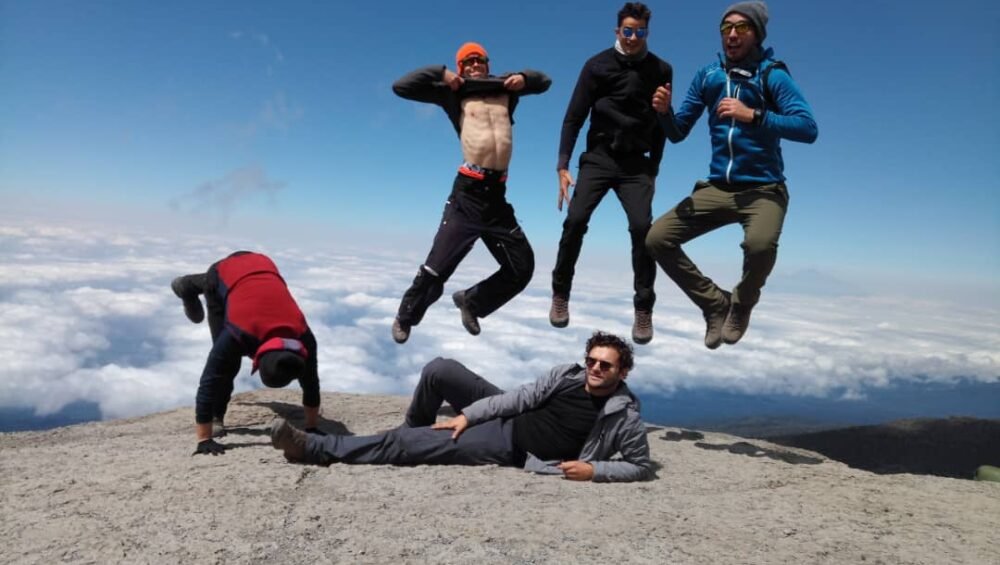
The world below is a sea of cloud stretching to every horizon. The glaciers glow orange and pink in the first light. The shadow of Kilimanjaro itself extends hundreds of kilometres to the west in a perfect triangular silhouette. The air is absolutely still. There are tears — from almost everyone, from some people who have never cried in public in their lives. There are hugs between strangers who walked through the night together. There is the famous sign at the summit, and photographs taken with shaking hands.
Most climbers spend 15–30 minutes at the summit. Your guide gently begins the descent after that — the cold, the altitude, and the long journey down all argue against lingering. You turn your back on the summit and begin the long walk home.
The descent: underrated and surprisingly hard
The descent from the summit to Mweka Camp is 1,795 vertical metres — one of the longest single descent days on any trekking route in Africa. After the exertion of summit night, on tired legs, in boots that have been on your feet for seven hours, the descent is a genuine physical test.
The volcanic scree that made the ascent slow and effortful becomes a rapid descent medium — some climbers learn to ski-walk down the loose surface, covering ground quickly. Others with sensitive knees find the long descent the hardest part of the entire climb. Trekking poles, used correctly, reduce the impact significantly.
As you descend into lower altitude zones, something remarkable happens. The headache — which may have been a constant presence since 3,500m — disappears. Appetite returns with a force that surprises you. The greens of the moorland zone look extraordinary after days of grey volcanic rock. Your body is recovering in real time as you descend, hour by hour.
By the time you reach Mweka Camp at 3,100m, most climbers feel physically exhausted but genuinely euphoric. The hardest thing is over. The summit is behind you.
The final morning: back to Moshi
The last day’s walk down through the rainforest to Mweka Gate is gentle, quiet, and often emotional. The forest feels lush and extraordinary after the barren upper mountain. The air is rich and thick with oxygen — a sensory luxury after days at altitude.
At the gate, summit certificates are presented by park rangers. There are photographs with the guide team and porters — the people who carried your bag, cooked your food, set up your tent, monitored your health, and walked you safely to the summit and back. Tips are given in a group ceremony that carries genuine warmth. These are not transactions — they are expressions of gratitude between people who have shared something meaningful.
Then the vehicle back to Moshi, a hot shower, the first cold beer, a meal that tastes better than any meal you can remember. And the quiet realisation, somewhere in the restaurant that evening, that something has shifted. You did a hard thing. The mountain asked for everything you had and you gave it. That does not go away.
What climbers say afterwards
- “I have run marathons and done triathlons. Nothing compared to summit night on Kilimanjaro.”
- “I cried at the summit and I am not a person who cries. I still don’t fully understand why.”
- “The porters carrying huge loads while we struggled with a daypack was one of the most humbling things I have ever seen.”
- “I felt terrible for most of Day 4 and thought I would have to turn back. By the next morning I felt fine. Altitude is strange.”
- “The pole pole pace drove me crazy in the first two days. By Day 5 I understood everything.”
- “The sunrise from Uhuru Peak. I will be trying to describe it for the rest of my life.”
| Plan your Kilimanjaro experience with Serac Adventure Our guides have walked this mountain hundreds of times — their knowledge and care make the difference. 8-day Lemosho and 7-day Machame from Moshi. All safety equipment. KINAPA-licensed. Contact us: +255 785 790 460 (WhatsApp) | info@seracadventure.com |