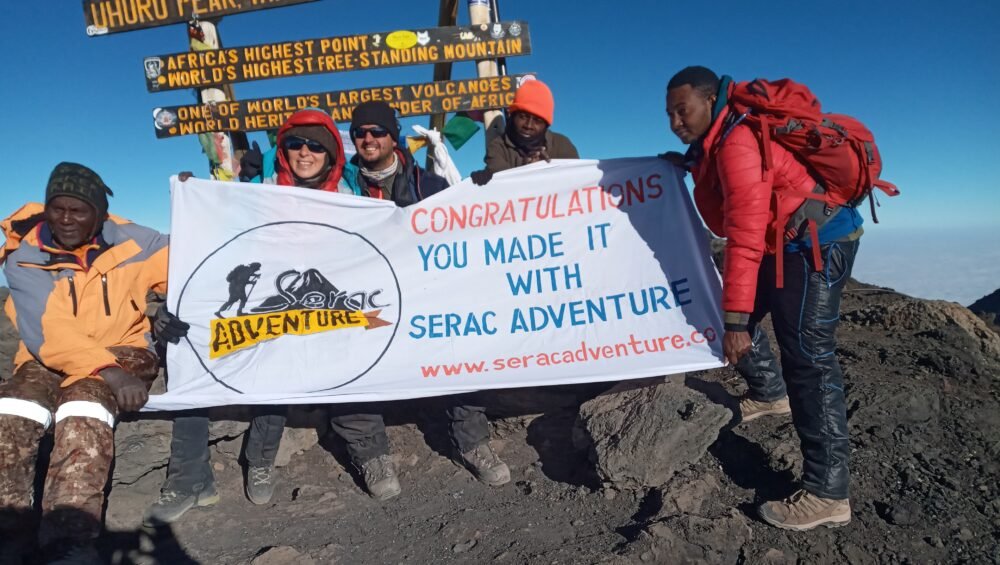
Marangu or Machame — it is the most common Kilimanjaro route dilemma. Both lead to Uhuru Peak. Both are popular with first-time climbers. Both are operated by Serac Adventure from our Moshi base. But they offer meaningfully different experiences, carry different summit success rates, provide different accommodation, and suit different types of trekker.
This comparison cuts through the marketing language and gives you the genuine differences — from an operator that runs both routes regularly and has seen how each affects climbers of all backgrounds.
| Quick comparison: Marangu vs Machame |
| Marangu — the ‘Coca-Cola Route’: huts, same trail up and down, shorter, less scenic |
| Machame — the ‘Whiskey Route’: camping, circuit trail, longer, more dramatic scenery |
| Duration: Marangu 5–6 days / Machame 6–7 days |
| Accommodation: Marangu = huts | Machame = tents |
| Summit success rate: Marangu 60–70% (6-day) | Machame 80–87% (7-day) |
| Serac Adventure price: Marangu 6-day from $1,860 / Machame 7-day from $1,700 |
| Our recommendation: Machame 7-day for most climbers; Marangu for those who prefer huts |
Route overview: the fundamental differences
The Marangu Route — the ‘Coca-Cola Route’
The Marangu Route is Kilimanjaro’s oldest and most established trail. It earned its “Coca-Cola Route” nickname partly because of its relative accessibility — the same way Coca-Cola is widely available everywhere. It is the only route on Kilimanjaro that uses permanent hut accommodation at every camp, and the only route that ascends and descends on the same path.
The Marangu approaches from the south-east via Marangu Gate, passes through beautiful rainforest and moorland, and reaches Kibo Hut at 4,703m before the final push to Uhuru Peak. It is the most straightforward and logistically simple route — one reason it remains popular with climbers who value predictability and comfort.
The Machame Route — the ‘Whiskey Route’
The Machame Route approaches from the south-west, offers a dramatically more scenic circuit around Kilimanjaro’s southern face, and descends via the Mweka Route rather than returning the same way. The “Whiskey Route” nickname implies something stronger and more demanding than the Coca-Cola Route — which is accurate. It is a more physical, more varied, and more visually spectacular experience.
The critical structural advantage of the Machame Route is its built-in acclimatisation day: on Day 3, climbers ascend to Lava Tower (4,630m) before descending to Barranco Camp (3,976m). This climb-high-sleep-low pattern is the most effective single acclimatisation strategy on any standard Kilimanjaro route, and it is the primary reason Machame has a measurably higher summit success rate than Marangu.
Head-to-head comparison across every factor
1. Accommodation — the biggest practical difference
This is where the routes diverge most dramatically. Marangu is Kilimanjaro’s only route with permanent bunkhouse huts at every camp. These provide dormitory-style bunk beds, shared dining halls, and toilets — basic but genuinely more comfortable than tent sleeping on cold mountain nights. The huts at Mandara (2,720m), Horombo (3,720m), and Kibo (4,703m) offer a level of physical comfort no other route can match.
Machame is a camping-only route. All accommodation is in mountain tents at each campsite. Serac Adventure uses high-quality expedition tents with sleeping mats. While comfortable, camping in tents at 4,000–4,600m altitude, in sub-zero temperatures, is a meaningfully different experience from sleeping in a hut bunk.
- Choose Marangu if: you strongly dislike camping, have back or joint issues that make ground sleeping uncomfortable, or are climbing in a cold month and want insulated walls around you at night.
- Choose Machame if: you are comfortable camping and do not need hut comfort — the summit success rate advantage of Machame is more valuable than the comfort difference for most climbers.
2. Scenery — Machame wins clearly
The Marangu Route passes through rainforest and moorland zones and offers fine views — but the ascent and descent on the same trail means you see the same landscape twice. The upper section above Horombo is relatively featureless lunar terrain on the final approach to Kibo Hut.
The Machame Route is Kilimanjaro’s most scenic standard trail. It traverses more diverse terrain than any other route — rainforest, open moorland, the Shira Plateau, the dramatic Lava Tower, the spectacular Barranco Valley (and its iconic Wall scramble), the alpine desert traverse to Karanga, and the final push to Barafu. Every camp offers a different and more dramatic view than the last. Machame’s scenery is genuinely exceptional by any global trekking standard.
3. Acclimatisation and summit success rate
| Route | Duration | Acclimatisation strategy | Summit success rate |
| Marangu | 5 days | Direct ascent — minimal | ~50–60% |
| Marangu | 6 days | One rest day at Horombo | ~60–70% |
| Machame | 6 days | Lava Tower day but cramped | ~65–75% |
| Machame | 7 days | Lava Tower + full circuit | ~80–87% |
The numbers tell a clear story. The 7-day Machame’s Lava Tower acclimatisation day — ascending to 4,630m before sleeping at 3,976m — is the most effective acclimatisation strategy among standard routes. The Marangu Route’s direct ascent profile gives the body less time to adapt, resulting in lower success rates despite the route’s reputation as the “easier” option.
The counterintuitive truth about Marangu: it is often assumed to be easier and therefore more likely to result in a successful summit. In reality, its shorter duration and direct ascent profile mean it has a lower success rate than 7-day Machame. The “easier” trail is not the more successful one.
4. Difficulty and terrain
Both routes are non-technical — no ropes, harnesses, or mountaineering skills required. The primary challenge on both is altitude. However:
- Marangu terrain: generally more gradual and straightforward. The trail is well-maintained and relatively gentle in gradient. Good for those with knee issues or who prefer steady, predictable footing.
- Machame terrain: steeper and more varied. The Barranco Wall scramble on Day 4 is genuinely physical — hands and feet required on loose rock. Multiple ridges and valleys create more cumulative elevation change. More demanding on the legs, particularly on the descent.
5. Crowds
Both routes are popular and neither is uncrowded in peak season (July–September). However, Machame is Kilimanjaro’s single most popular route and camps can feel busy, particularly at Barranco and Barafu during peak months. The Marangu Route huts have fixed capacity — meaning each hut has a set number of beds and the route cannot exceed a certain daily volume. This gives Marangu a natural crowd-limiting mechanism.
- Machame camps: can feel crowded at Barranco and Barafu in peak season, with many operators sharing the same campsites.
- Marangu huts: have fixed bed capacity which limits crowding, but dormitory-style bunk rooms mean you share sleeping space with strangers.
6. Cost
Marangu is generally slightly more expensive per day than Machame due to the hut accommodation fees, which are higher than camping fees. However, the shorter duration means the total package cost can be lower.
| Route | Duration | Serac Adventure price from (group rate) |
| Marangu | 6 days | $1,860 per person |
| Machame | 6 days | $1,500 per person |
| Machame | 7 days | $1,700 per person |
| Lemosho | 8 days | $1,900 per person (recommended) |
7. The down-and-back vs circuit experience
The Marangu Route ascends and descends on exactly the same trail. There is a practical advantage — the familiar terrain on descent helps with navigation and pace management. The psychological disadvantage is seeing the same landscape twice when your legs are already tired.
The Machame Route follows a complete circuit — up via Machame and down via the Mweka Route. The descent is a different trail entirely, passing through different campsites and vegetation zones. Many climbers find this circuit format more satisfying as a complete mountain experience.
The decision guide — which route is right for you?
| Choose Marangu (6 days) if you: |
| Have a genuine dislike of tent camping and sleeping on the ground |
| Are climbing in a very cold month and want hut walls around you at night |
| Have budget constraints — 6 days is shorter and the total cost is lower |
| Are doing a second or third Kilimanjaro climb and want to experience the other route |
| Are comfortable with a lower summit success rate (60–70%) in exchange for hut comfort |
| Choose Machame (7 days) if you: |
| Want the highest summit success rate of the two routes |
| Are comfortable camping or open to trying it |
| Want the most scenic and varied trail experience on Kilimanjaro |
| Are a first-time climber who wants the best possible conditions for a successful summit |
| Can commit to 7 days on the mountain |
| Serac Adventure’s honest recommendation For most first-time climbers choosing between just these two routes, we recommend 7-day Machame. The 20 percentage point advantage in summit success rate is the single most important factor for the majority of clients. If comfort is genuinely your priority and camping is not for you, 6-day Marangu is a perfectly valid choice — just go in with realistic expectations about success rates. However: if you can add one more day, the 8-day Lemosho Route outperforms both — better scenery than Machame, better acclimatisation than either, and a 90–95% success rate. Contact us to discuss which route is genuinely right for your specific situation: +255 785 790 460 |
Frequently asked questions: Marangu vs Machame
Is Marangu really easier than Machame?
The trail gradient is gentler on Marangu, so in purely physical terms it is somewhat less demanding day-to-day. But the lower success rate tells the real story — Marangu’s shorter duration and less effective acclimatisation means more climbers fail to reach the summit. ‘Easier trail’ does not equal ‘easier to summit’.
Can I book a private tent on the Marangu Route?
No — the Marangu Route huts provide dormitory bunk beds only. You cannot request a private sleeping space. The huts are comfortable but shared. On Machame and all camping routes, Serac Adventure provides individual tents for each climber (or couple sharing).
Which route has better views?
Machame — significantly. The Shira Plateau, Lava Tower, Barranco Valley, and the southern circuit traverse offer extraordinary and constantly changing scenery. The Marangu Route’s views are pleasant but comparatively limited, particularly since you see the same landscape on the way up and down.
What if I want comfort AND a high success rate?
Consider the Lemosho Route (8 days) — it has the best success rate of any standard route (90–95%) while offering the most spectacular scenery. The accommodation is camping throughout, but the longer duration and superior acclimatisation profile more than compensate. Our top recommendation for first-time climbers who can commit to 8 days.
| Book the Marangu or Machame Route with Serac Adventure Both routes available year-round. Group and private options. All park fees, guides, porters, meals included. Marangu 6-day from $1,860 pp | Machame 7-day from $1,700 pp | Lemosho 8-day from $1,900 pp Contact us: +255 785 790 460 (WhatsApp) | info@seracadventure.com |