The Ngorongoro Crater is one of the most extraordinary places on Earth. The world’s largest intact volcanic caldera — 19 kilometres across and 610 metres deep — forms a self-contained wildlife sanctuary that shelters over 25,000 animals within its walls. Lions, elephants, black rhinoceros, hippos, and flamingos share this ancient cauldron with the last healthy population of black rhino in Tanzania. Many experienced safari guides consider Ngorongoro Crater the single most reliable place on the continent to see the Big Five in one day.
This guide covers everything you need to know before your Ngorongoro Crater visit — geology, wildlife, entry fees, crater descent rules, the best time to go, accommodation options, and practical day-trip advice from Serac Adventure’s safari team.
| Ngorongoro Crater at a glance |
| Location: Ngorongoro Conservation Area (NCA), northern Tanzania — 180km west of Arusha |
| Size: 260 km² crater floor — approximately the size of Mexico City |
| Depth: 610 metres from rim to floor |
| UNESCO World Heritage Site: designated 1979 |
| Annual wildlife count: 25,000+ animals permanently resident on the crater floor |
| Formed: approximately 3 million years ago by volcanic collapse |
| Ngorongoro Conservation Area (NCA) total size: 8,292 km² |
| Entry fee: ~$70 per person per day + $295 per vehicle for crater descent |
The geology: how the crater was formed
Approximately three million years ago, a massive volcanic peak — estimated to have stood between 4,500 and 5,000 metres high, potentially taller than Kilimanjaro — erupted catastrophically and then collapsed inward upon itself. Rather than exploding outward, the magma chamber beneath emptied and the summit fell inward, creating the vast bowl-shaped caldera we see today.
Millions of years of rainfall, volcanic soil mineralisation, and ecological succession transformed the crater floor into one of the most fertile and productive ecosystems in Africa. The crater walls form a natural enclosure that effectively prevents most wildlife from leaving — creating a permanently high-density wildlife population with no parallel anywhere on the continent.
Wildlife in the Ngorongoro Crater
The Ngorongoro Crater hosts one of the densest wildlife populations in Africa within its 260 square kilometre floor. The variety and concentration of animals makes it unique among safari destinations.
Black rhinoceros — Tanzania’s best sighting opportunity
The Ngorongoro Crater holds one of Africa’s most important black rhino populations and is the best single place in Tanzania to see this critically endangered species. Approximately 20–30 black rhino are resident on the crater floor, and sightings — while not guaranteed — are far more reliable here than anywhere else in northern Tanzania. Your guide will have up-to-date information on where rhino are currently ranging on the crater floor.
Lion
The crater’s lion prides are famous and exceptionally well-studied. Ngorongoro lions have been observed to be slightly larger than Serengeti lions, possibly due to the crater’s rich prey base. Lionesses often hunt cooperatively in the early morning on the open crater floor. Male lions with distinctive dark manes are a characteristic feature — some crater males are among the most photogenic in Africa.
Elephant
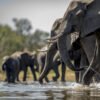
A resident elephant population lives on the crater floor year-round, with more individuals descending from the outer forests periodically. The crater’s bulls are particularly impressive — old, large-tusked males that are among the most striking elephant sightings in East Africa. Elephants are most frequently encountered in the forested sections and along the Lerai Forest on the crater’s southern floor.
Hippo and flamingo — Lake Magadi
The shallow, alkaline Lake Magadi at the centre of the crater floor supports a large hippo pod — some of the most visible and easily photographed hippos in Tanzania. The lake also attracts thousands of lesser flamingos, turning its edges pink during peak months. The flamingo numbers fluctuate with water levels and alkalinity but are often spectacular from July to October.
Spotted hyena
The Ngorongoro Crater has one of the world’s most intensively studied spotted hyena populations. Hyena clans here are exceptionally large — some containing 50–100 individuals — and hyenas are the dominant predator on the crater floor by numbers, hunting independently rather than relying on scavenging. Dawn drives frequently encounter hyenas returning from overnight hunts.
Cheetah and leopard
Both species are present in the crater though less commonly seen than on the open Serengeti plains. Cheetahs occasionally descend from the rim to hunt on the floor but generally prefer the more open terrain outside. Leopards are resident and most commonly spotted in the Lerai Forest and along rocky outcrops near the crater walls.
Other wildlife highlights
- Cape buffalo: Large herds — several thousand — are permanent crater residents. The primary prey for the crater’s lions.
- Wildebeest: Resident population of approximately 7,000 that does not migrate — in contrast to the vast Serengeti herds.
- Zebra: Large resident herds on the crater floor year-round.
- Jackals (golden and black-backed): Commonly seen scavenging and opportunistically hunting on the floor.
- Maasai ostrich: The world’s largest bird is commonly seen on the open crater grasslands.
- Kori bustard: The world’s heaviest flying bird — frequently seen walking across the crater floor.
Birdlife: over 500 species recorded
The Ngorongoro Crater is a premier birding destination. More than 100 species are found here that do not occur in the Serengeti, including ostriches, kori bustards, secretary birds, crowned cranes, lesser flamingos, and a remarkable variety of raptors. The crater rim forests host different species again — including Augur buzzard, Verreaux’s eagle, and various sunbird species. Over 500 total species have been recorded in the Ngorongoro Conservation Area.
Entry fees and crater descent rules
The Ngorongoro Conservation Area has specific access regulations that differ from standard national parks. Understanding these before your visit prevents surprises.
| Fee component | Amount | Notes | ||
| NCA entry fee (adult) | ~$70 per person per 24 hours | All international non-resident visitors | ||
| NCA entry fee (child 5–15) | ~$20 per person per 24 hours | |||
| Crater descent fee (vehicle) | $295 per vehicle | Mandatory for all vehicles descending to floor | ||
| Camping fee | $70 per person per night | Within the NCA | ||
| Conservation levy | $10 per person (one-off) | |||
| Important crater descent rules — 2026 Maximum time on the crater floor: 6 hours per descent — enforced by rangers. No standing in open vehicles on the crater floor — all game viewing through windows or roof hatches only. No off-road driving on the crater floor — strictly on designated tracks. All vehicles must exit the crater via the designated ascent road by the stated time. A limited number of vehicles are permitted on the crater floor daily — book well in advance during peak season. No walking on the crater floor except at designated picnic areas. | ||||
How to visit the Ngorongoro Crater
Day trip from Arusha or Moshi (most common)
The vast majority of visitors experience Ngorongoro as a one-day crater descent within a larger northern circuit safari. The standard approach is to stay at a crater rim lodge overnight (or drive from Karatu town), descend at first light — usually 7am — and spend the full six permitted hours on the crater floor before ascending in the early afternoon. This is the most efficient way to experience the crater and the standard itinerary in all Serac Adventure safari packages.
Multi-day stay in the Conservation Area
A small number of visitors stay multiple nights within the NCA, allowing multiple crater descents and exploration of the broader Conservation Area including Olduvai Gorge (where some of the most significant early human fossil discoveries were made). This is particularly popular with serious wildlife photographers who want early morning and late afternoon light on multiple days.
Combining Ngorongoro with the Serengeti
Ngorongoro sits at the eastern entrance to the Serengeti — almost all northern circuit safaris combine both parks. The standard route drives through the NCA on the way to or from the Serengeti, making a crater descent a natural addition to any Serengeti safari. Serac Adventure includes Ngorongoro in all standard northern circuit packages.
Best time to visit the Ngorongoro Crater
Unlike the Serengeti, Ngorongoro Crater offers excellent wildlife viewing year-round because the resident animal population does not migrate away from the crater floor. That said, certain months offer specific advantages:
| Season | Months | Conditions | Highlights |
| Dry season | Jun–Oct | Best visibility, clear skies | Peak wildlife viewing, flamingo numbers at Magadi |
| Short dry season | Jan–Mar | Clear, warm, less crowded | Good general wildlife, calving season visible from rim |
| Green season | Apr–May, Nov | Lush, fewer visitors, lower prices | Outstanding birding, fewer vehicles on crater floor |
| December | Dec | Transitional, quiet | Good value, improving conditions |
Accommodation options
Crater rim lodges (recommended for crater access)
Staying on the crater rim gives you the advantage of the earliest possible descent, which means first light on the crater floor — often the best time for wildlife activity and photography. The rim is approximately 2,300m above sea level, so evenings are cool to cold. Accommodation on the rim ranges from mid-range to ultra-luxury.
- Mid-range: Ngorongoro Oldeani Mountain Lodge, Rhino Lodge — approximately $200–400 per person per night full board.
- Luxury: Ngorongoro Crater Lodge, andBeyond Ngorongoro Crater Lodge — from $800 per person per night, often $1,500+.
Karatu town (budget option)
Karatu is a small town approximately 10km east of the main NCA gate. Budget and mid-range guesthouses and lodges here are significantly less expensive than the rim. The trade-off is a 45–60 minute drive to the gate, then another 20–30 minute descent to the crater floor — meaning you lose the advantage of a very early start. Good option for budget travellers.
Olduvai Gorge — an optional add-on
Located within the Ngorongoro Conservation Area approximately 45km from the crater, Olduvai Gorge is one of the most important palaeontological sites in the world. It was here that Louis and Mary Leakey discovered fossil remains of Homo habilis and Paranthropus boisei in the 1950s and 1960s — fundamentally changing our understanding of human evolution. A small but excellent museum at the gorge tells the story of 3.7 million years of human prehistory. Most northern circuit itineraries include a 30–45 minute stop.
Frequently asked questions: Ngorongoro Crater
Can you see all the Big Five at Ngorongoro Crater?
Yes — this is one of only a handful of places in Africa where seeing all five (lion, leopard, elephant, buffalo, black rhino) in a single day is a realistic possibility. The crater’s naturally enclosed ecosystem means all five species are resident year-round. Rhino sightings require some patience and luck, but the crater is by far the best option in Tanzania for black rhino.
How long do you spend on the crater floor?
All vehicles are limited to a maximum of six hours on the crater floor per descent — strictly enforced by park rangers. Most groups descend at around 7am and exit by 1–2pm. This provides enough time to cover the main crater floor areas including Lake Magadi, the hippo pools, the Lerai Forest, and the central plains.
Is the Ngorongoro Crater worth the high entry fees?
Yes — the $295 per vehicle crater descent fee is steep, but the Ngorongoro Crater consistently delivers one of the most concentrated and accessible wildlife experiences in Africa. When the cost is shared across a vehicle of 4–6 people, it becomes approximately $50–75 per person on top of the standard park entry. For most visitors, it represents extraordinary value relative to the experience.
Do you need to book the crater in advance?
In peak season (July–October), crater descent slots can fill up — particularly for groups requiring multiple vehicles. Serac Adventure handles all booking, permits, and logistics for our safari clients. If you are planning a visit in peak season, book your safari at least 3–4 months ahead.
| Visit Ngorongoro Crater with Serac Adventure We include Ngorongoro Crater in all northern circuit safaris as a standard day descent. Private vehicle, certified naturalist guide, all fees, accommodation, and meals included. Contact us: +255 785 790 460 (WhatsApp) | info@seracadventure.com |