Approximately 35,000–50,000 people attempt Kilimanjaro every year. Of those, the overall summit success rate is typically quoted at 65–80%. But that average hides enormous variation — and understanding what drives the numbers is the key to placing yourself at the high end of the range.
This post gives you the data, the honest analysis, and the seven controllable factors that determine whether you stand on Uhuru Peak or turn back below the crater rim. Written by Serac Adventure’s guide team in Moshi, based on years of monitoring our own climbers and the mountain’s broader statistics.
| Kilimanjaro success rate — key statistics 2026 |
| Overall summit success rate (all routes, all operators): approximately 65–80% |
| 5-day route success rate: approximately 27–45% |
| 6-day route success rate: approximately 50–65% |
| 7-day route success rate: approximately 75–87% |
| 8-day Lemosho Route (reputable operator): approximately 90–95% |
| Northern Circuit 9-day (reputable operator): approximately 93–95% |
| Industry-wide, altitude sickness is responsible for approximately 80% of failed summits |
| Annual evacuations from Kilimanjaro: approximately 1,000–1,500 per year |
What counts as a summit?
Before discussing rates, one critical point: Kilimanjaro has three recognised high points, and different operators define “summit” differently. This matters because it directly affects how you should interpret any success rate claim.
| Point | Elevation | What it is | Certificate |
| Gilman’s Point | 5,681m (18,638ft) | Crater rim — eastern edge (Marangu Route) | Bronze certificate |
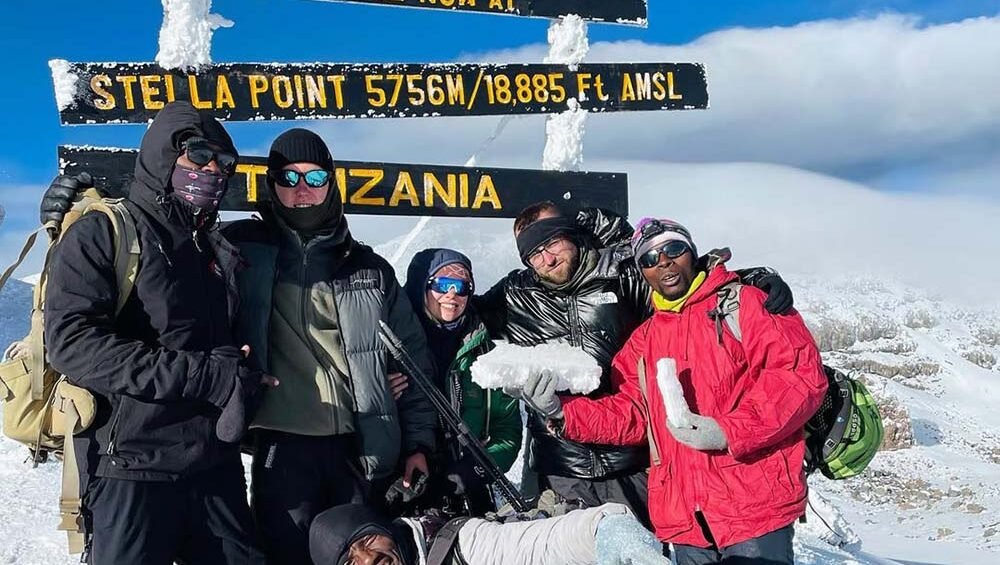
| Stella Point | 5,756m (18,885ft) | Crater rim — southern edge (Machame, Lemosho) | Bronze certificate |
| Uhuru Peak | 5,895m (19,341ft) | True summit — highest point in Africa | Gold certificate |
Some operators count Stella Point arrivals as summits in their statistics, inflating their reported success rates. When Serac Adventure reports success rates, we mean Uhuru Peak — the true summit. Always ask any operator to clarify whether their rate means Gilman’s, Stella Point, or Uhuru Peak.
Success rates by route — the data
| Route | Standard duration | Success rate (reputable operator) | Why | ||
| Marangu | 6 days | 60–70% | Shortest standard route — limited acclimatisation time | ||
| Machame | 6 days | 50–65% | Too fast — 6-day version not recommended | ||
| Machame | 7 days | 80–87% | Good acclimatisation with Lava Tower day | ||
| Rongai | 7 days | 78–85% | Northern approach — drier but good profile | ||
| Lemosho | 7 days | 85–90% | Excellent — Shira Plateau adds acclimatisation | ||
| Lemosho | 8 days | 90–95% | Best standard route — highest acclimatisation | ||
| Northern Circuit | 9 days | 92–95% | Longest route — maximum acclimatisation | ||
| Umbwe | 6–7 days | 45–60% | Steepest, fastest — high AMS risk | ||
| The most important number in the table The difference between a 6-day Marangu (60–70%) and an 8-day Lemosho (90–95%) is 20–35 percentage points. That is the difference between a 1 in 3 chance of failure and a 1 in 14 chance of failure. The extra days cost money — but they are the most valuable investment you can make in your summit chances. | |||||
The 7 factors that determine your summit success
Factor 1: Route length — the biggest variable
Every additional day above 3,000 metres adds approximately 5–10 percentage points to your summit success. The physiology is clear: acclimatisation takes time. Your body needs to produce more red blood cells, increase respiratory rate, and adjust blood chemistry to cope with reduced oxygen pressure. These adaptations do not happen overnight — they require sustained exposure to altitude over multiple days.
The “climb high, sleep low” principle built into the Lemosho and Machame routes — where climbers ascend to Lava Tower (4,630m) before sleeping at Barranco (3,976m) — is the most powerful single acclimatisation strategy on the standard routes. It exposes the body to extreme altitude without the risk of sleeping there.
Factor 2: Operator quality — widely underestimated
Budget operators and reputable operators are not equal — and the success rate data proves it. Reputable operators with experienced guides, proper safety equipment, daily health monitoring, and honest acclimatisation pacing consistently achieve 85–95% summit success. Budget operators cutting corners on guides, food, safety equipment, and pacing see rates as low as 50–70% on the same routes.
What makes the difference in operator quality:
- Experienced lead guides who have completed hundreds of summit ascents and know the mountain intimately
- Daily pulse oximeter readings and Lake Louise Score health assessments at every camp
- Supplemental oxygen and emergency first aid equipment on every climb
- Honest pace management — guides who resist clients’ urges to walk faster than is safe
- Proper nutrition — hot, calorie-rich meals at every camp maintained by a dedicated cook
- Willingness to recommend descent when a climber’s health requires it
Factor 3: Altitude sickness susceptibility — the uncontrollable variable
Altitude sickness does not discriminate. Elite athletes have failed on Kilimanjaro while sedentary office workers have summited. Previous altitude experience reduces risk but does not eliminate it. There is no reliable way to predict individual susceptibility before arrival.
What is known: certain factors increase AMS risk.
- Previous AMS history: Those who have experienced AMS before are statistically more likely to experience it again, though route choice and pacing can significantly mitigate this.
- Rapid ascent: The faster you go, the less time your body has to adapt. Short routes and rushed pacing dramatically increase AMS incidence.
- Dehydration: Dehydration worsens AMS symptoms reliably. Drinking 3–4 litres of water daily is one of the most evidence-based strategies for reducing AMS risk.
- Alcohol: Alcohol at altitude impairs sleep quality, worsens dehydration, and exacerbates AMS symptoms. It should be avoided completely during the climb.
Factor 4: Physical fitness and preparation
Fitness does not prevent altitude sickness but it does affect summit success. Fit, well-trained climbers manage the multi-day physical demand better — they arrive at Barafu Camp with more energy reserves for summit night, recover faster between days, and suffer less from cumulative fatigue.
The specific fitness components that matter most:
- Cardiovascular endurance for sustained 4–7 hour hiking days
- Leg strength for repeated steep ascent and the demanding descent from the summit
- Multi-day recovery capacity — the ability to perform adequately on tired legs
- Mental resilience — the capacity to keep moving when tired and uncomfortable at altitude
Factor 5: Summit night preparation and gear
The summit night ascent is where the vast majority of turnarounds occur. The temperature at the crater rim before dawn frequently reaches -15°C to -20°C with wind chill — temperatures that are genuinely dangerous without adequate gear. Many turnarounds on summit night are caused not by altitude sickness but by severe cold and wind that the climber is inadequately equipped for.
Adequate summit night gear includes: thermal base layers, fleece mid-layer, down jacket, waterproof shell, balaclava, insulated mittens, and gaiters over waterproof boots. See the full Kilimanjaro packing list for details.
Factor 6: Season choice
Climbing during Tanzania’s dry seasons (January–March and June–October) improves summit success for two reasons: trail conditions are better and temperatures, while cold, are more stable and predictable. The long rains (April–May) create wet, slippery trails and persistent cloud cover that makes summit night navigation harder. Success rates are measurably lower during the rainy seasons.
Factor 7: Mental preparation and decision-making
Kilimanjaro is a psychological test as much as a physical one. The decision to continue or turn back on summit night — made at 4am in darkness, cold, and exhaustion at 5,300–5,500m — is one of the most significant decisions a climber makes. Specific mental preparation matters:
- Knowing in advance what is normal: Severe headache, nausea, dizziness, and profound fatigue are expected on summit night. Climbers who know this is coming are better able to differentiate between normal discomfort and genuine AMS warning signs.
- Setting a realistic turnaround time: Discuss with your guide before summit night: if we have not reached Stella Point by [time], we turn back. This removes decision-making under extreme duress.
- Trusting your guide: Your guide has done this hundreds of times. If they recommend turning back, there is a reason. The mountain will still be there. Your health will not recover from a serious altitude emergency at 5,800m.
How to maximise your Kilimanjaro success rate — a practical checklist
| Action | Impact on success rate | Priority |
| Choose 8-day Lemosho or 7-day Machame route | Very high — +15 to +25 percentage points vs 6-day | Non-negotiable |
| Book with a reputable, licensed local operator | Very high — +15 to +20 points vs budget operator | Non-negotiable |
| Complete 8–12 week structured training programme | High — reduces fatigue, improves mental resilience | Essential |
| Invest in proper summit night gear | High — cold is a leading cause of turnaround | Essential |
| Stay hydrated (3–4L water daily on mountain) | Moderate — dehydration worsens AMS | Important |
| Consider Diamox (discuss with your doctor) | Moderate — reduces AMS incidence | Recommended |
| Climb in dry season (Jan–Mar or Jun–Oct) | Moderate — better conditions and visibility | Recommended |
| Take a rest day in Moshi before climbing | Low-moderate — jet lag recovery | Useful |
What Serac Adventure’s success rates look like
Serac Adventure reports success rates based on Uhuru Peak arrivals — the true summit at 5,895m. Our rates across all routes are consistently above the industry average due to:
- We do not operate 5-day Kilimanjaro climbs — minimum 6 days, and we actively recommend 7–8 days
- Daily pulse oximeter readings and Lake Louise Score assessments at every camp on every climb
- Supplemental oxygen and emergency first aid equipment carried on all climbs
- Guides trained to maintain pole pole pace regardless of client pressure
- Honest health conversations — we tell clients clearly when we are concerned about their AMS severity
- Post-summit data tracking — we record every climber’s summit outcome and analyse it for continuous improvement
Frequently asked questions about Kilimanjaro success rates
Is a 65% success rate accurate for Kilimanjaro overall?
The 65–80% figure is broadly accurate for the industry as a whole across all routes and operators. However, it masks enormous variation. A first-time climber on a 5-day budget Marangu climb might have a 40–50% chance of summiting. The same person on an 8-day Lemosho with a reputable operator might have a 90–95% chance. Route and operator selection are within your control — use them.
Does age affect summit success?
Not significantly — not in the way most people expect. Physical fitness matters more than age. Studies of Kilimanjaro climbers show that well-prepared older climbers (50–70s) regularly outperform younger but less-prepared climbers. The oldest person to summit Kilimanjaro was 89. The minimum age (set by KINAPA) is 10 years.
Can fitness training improve my summit success rate?
Yes — substantially. Fitness does not prevent altitude sickness but it reduces the compounding effect of fatigue on AMS symptoms, improves your ability to eat and drink consistently (critical for hydration and acclimatisation), and provides the mental reserve to maintain forward movement on summit night when your body is telling you to stop.
What is Serac Adventure’s summit success rate?
Our Uhuru Peak success rate on 8-day Lemosho climbs is consistently between 90–95%. On 7-day Machame we achieve 82–88%. We do not inflate these figures by counting Stella Point arrivals as summits, and we do not cherry-pick data. These are our honest, tracked results across all client climbs.
| Book your Kilimanjaro climb with Serac Adventure 8-day Lemosho Route — our top recommendation for the highest summit success rate. All safety equipment, daily health monitoring, experienced KINAPA guides. Packages from $1,900 per person. Full transparency on what you are paying for. Contact us: +255 785 790 460 (WhatsApp) | info@seracadventure.com |