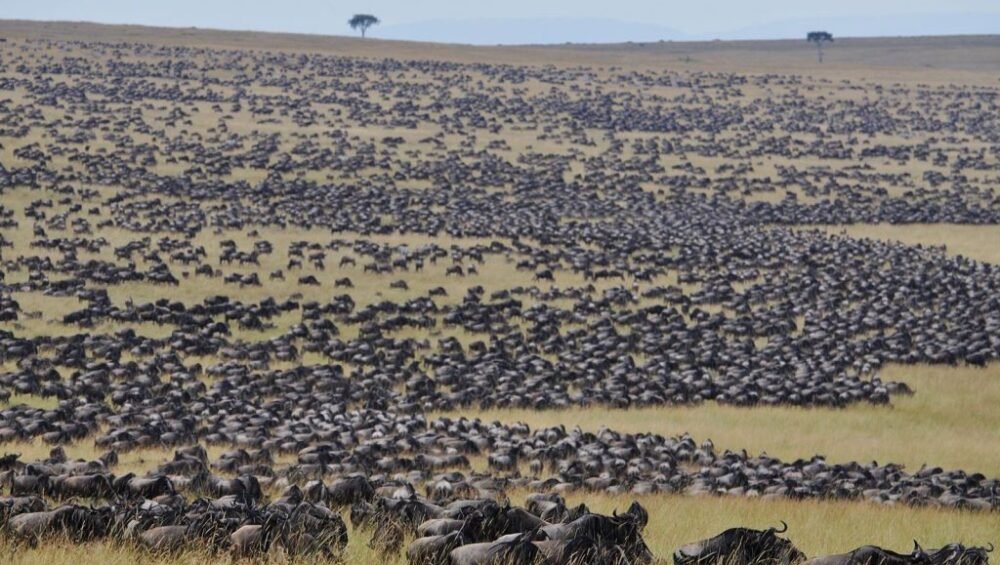
The Great Wildebeest Migration is the greatest wildlife spectacle on Earth. Every year, over 1.5 million wildebeest — accompanied by approximately 300,000 zebra and 500,000 gazelle — move in a continuous clockwise circuit across the Serengeti-Mara ecosystem, covering roughly 800 kilometres in an annual journey dictated entirely by rainfall and the growth of new grass. No zoo, no reserve, no carefully staged wildlife encounter comes close to the raw, overwhelming scale of this phenomenon.
Tanzania hosts the majority of the Migration for most of the year — from the extraordinary calving season on the southern Serengeti plains in January and February, through the long northward journey across the central and western Serengeti, to the famous Mara River crossings from July to October. Understanding the Migration calendar is the key to planning a safari that puts you in the right place at exactly the right time.
| The Great Migration at a glance |
| Animals involved: 1.5 million wildebeest, 300,000+ zebra, 500,000+ gazelle |
| Total circuit distance: approximately 800km through Tanzania and Kenya |
| Annual calves born: approximately 400,000–500,000 during calving season (Jan–Feb) |
| Ecosystem: Serengeti National Park (Tanzania) and Masai Mara National Reserve (Kenya) |
| Tanzania’s share of the Migration: approximately 9–10 months of the annual cycle |
| Primary driver: rainfall and fresh grass growth — the exact timing shifts year to year |
| Best Mara River crossing months: July–October in northern Serengeti |
| Best calving season months: January–February in Ndutu / southern Serengeti |
What is the Great Migration — and why does it happen?
The Migration is not a single dramatic event — it is a continuous, year-round movement driven by one fundamental imperative: survival. Wildebeest, zebra, and gazelle follow rainfall and the growth of fresh grass across a continuous ecosystem that straddles the Tanzania-Kenya border. They move not because of instinct alone but because standing still means starvation — the herds consume the available grass in any given area within weeks.
The ecosystem is one continuous wilderness divided by a political border. The Serengeti in Tanzania and the Masai Mara in Kenya are not separate wildlife areas — they share the same soil, the same grass, the same rivers, and the same predators. Animals cross the border freely. Travellers do not — which is why understanding which side of the border the herds are on at any given time is essential for safari planning.
What drives the timing? Primarily rainfall. The herds move toward areas of recent rain where fresh grass is growing, and away from areas they have already consumed. Because rainfall patterns shift year to year, the exact Migration calendar is never precisely predictable — the dates given in any guide (including this one) are patterns, not guarantees.
The full year-round Migration calendar
The following is Tanzania and Kenya’s Migration calendar based on historical patterns. Expect shifts of 2–6 weeks in any given year depending on rainfall.
| December–January | Southern Serengeti / Ndutu | Herds returning south. First calves beginning. Pre-calving concentration on short-grass plains. |
| January–March | Ndutu / Southern Serengeti | CALVING SEASON. 400,000+ calves born. Extraordinary predator action. Best for cheetah, lion, wild dog. |
| March–April | Central Serengeti / Seronera | Herds moving north. Long rains beginning. Mating season (rut). Lush green landscape. |
| May–June | Western Corridor / Grumeti | Herds concentrated in western Serengeti. First Grumeti River crossings. Crocodile encounters begin. |
| July–October | Northern Serengeti / Mara River | PEAK CROSSING SEASON. Iconic Mara River crossings. Herds entering Kenya’s Masai Mara. |
| October–November | Eastern Serengeti / Loliondo | Herds returning south. Short rains beginning. Quieter but still substantial wildlife. |
The calving season — January to March (Tanzania’s secret weapon)
The calving season in the southern Serengeti is the Great Migration’s most underrated spectacle — and in many ways its most extraordinary. Every year between January and early March, approximately 400,000–500,000 wildebeest calves are born on the short-grass Ndutu plains near the Ngorongoro Conservation Area boundary. At the peak of calving in February, it is estimated that around 8,000 calves are born every single day.
The concentration of newborns draws every predator in the ecosystem. Cheetah families work the open plains hunting calves with terrible efficiency. Lion prides ambush the edges of moving herds. Leopards stalk the twilight hours. Hyena clans follow the herd margins. Wild dogs — rare even in the Serengeti — are regularly seen at Ndutu during calving season.
The Ndutu area during calving is, in the opinion of many experienced safari guides, the most intense and emotionally powerful wildlife experience in Africa. The open, short grass provides near-perfect visibility. The drama of birth, survival, and predation plays out continuously — sometimes simultaneously in multiple directions. And the vast majority of travellers have never heard of it.
| Why calving season is Serac Adventure’s top Migration recommendation January–February in Ndutu offers Migration wildlife on par with the Mara River crossings — but with far fewer tourists. The open short-grass plains give exceptional visibility for photography and sightings. Accommodation prices are significantly lower than peak season (July–September). Combine with Ngorongoro Crater (just 45 minutes away) for the best overall Tanzania safari experience. Ask us about our calving season safari packages: +255 785 790 460 |
The Grumeti River crossings — June to July
Before the herds reach the famous Mara River, they must first cross the Grumeti River in the western corridor of the Serengeti. The Grumeti crossings are less publicised than the Mara but equally dramatic — the resident Grumeti crocodiles are among the largest on the continent, and the western corridor sees far fewer safari vehicles than the northern areas.
The western corridor between May and July offers an excellent Migration safari with genuine exclusivity. The herds here are moving purposefully northward, predator activity is high, and the riverine forest and open woodland of this area create a different aesthetic from the open plains of the south or the rocky northern Serengeti.
The Mara River crossings — July to October
The Mara River crossings are what most people picture when they think of the Great Migration — thousands of wildebeest plunging into crocodile-infested water, scrambling up steep muddy banks, thundering across the river in a mass that stretches for hundreds of metres. The crossings happen in the northern Serengeti near Kogatende, where the Mara River curves south from Kenya and back north again, creating multiple potential crossing points.
The mechanics of a crossing are both spectacular and unpredictable. The herds will mass at the river bank — sometimes for hours, sometimes for days. The lead animals approach the water, the herd energy builds into a desperate urgency, and suddenly thousands of animals are in the river simultaneously. Crocodiles take some. Others are swept downstream and drown. The survivors emerge on the far bank and scatter into the distance. The whole sequence can last 20 minutes or two hours.
Then it can happen again. And again. The same crossing point can see dozens of crossings in peak season as the herds work their way north in stages.
How to see the Mara River crossings — practical advice
- When to go: July through October is crossing season, with July–September offering the highest frequency. October crossings still occur but herds begin moving south.
- Where to stay: In the northern Serengeti near Kogatende, or fly-in camps adjacent to the river. Mid-range and luxury camps in this area position you within 30 minutes of the main crossing points.
- How to reach the northern Serengeti: Either a long drive from Arusha/Moshi (8–10 hours via Serengeti central) or a charter flight to Kogatende or Lamai airstrips (approximately 1 hour from Arusha). The drive is spectacular but the additional days required may affect your itinerary.
- Patience is essential: The crossings are not scheduled. You may wait at the river for two hours and witness nothing, then have the most dramatic crossing of your life. Guides track herd movements daily and position vehicles where crossings are most likely. Trust your guide’s positioning decisions.
- Multiple crossings are possible: A single crossing point can be active for several days during peak season. Spending two or three nights in the northern Serengeti during July–September significantly increases your chances of witnessing multiple crossings.
Migration viewing: Tanzania vs Kenya
One of the most common questions: should I see the Migration from the Tanzania side or the Kenya side? The honest answer depends on timing and what you want from the experience.
| Aspect | Tanzania (Serengeti) | Kenya (Masai Mara) |
| Migration duration | Year-round (different stages) | July–October (Mara crossings) |
| Calving season | Jan–Mar (Ndutu) — exceptional | Not hosted in Kenya |
| River crossings | Jul–Oct (northern Serengeti) | Aug–Oct (Mara River, Kenya side) |
| Park size | 14,763 km² — vast wilderness | 1,510 km² — smaller, more accessible |
| Visitor density | Lower per km² | Higher, especially at crossing points |
| Cost | Higher park fees | Lower park fees |
| Best for | Calving season, wider Migration | Easy access, shorter trips |
Our recommendation: For the calving season (January–March), Tanzania is the only option. For river crossings (July–October), both sides offer spectacular viewing — Tanzania’s northern Serengeti has lower vehicle density and a wilder feel; Kenya’s Mara side is closer to Nairobi and easier to reach. Combining both countries in a 10–14 day itinerary gives the most complete Migration experience.
Migration safari practicalities
How many days do you need?
- Minimum for calving season: 3 days based near Ndutu. 2 full game drives gives a reasonable chance of witnessing calving and predator action.
- Minimum for river crossings: 3–4 nights in northern Serengeti. Crossing frequency varies — 4 nights gives a much better chance than 2.
- Ideal for a complete Migration safari: 7–10 days covering calving season (if January–March) or central Serengeti plus northern crossing area (July–September).
How far in advance should you book?
- For peak crossing season (July–September): 6–12 months in advance. Northern Serengeti camps fill early.
- For calving season (January–February): 3–6 months ahead is usually sufficient.
- For green season (April–May): shorter notice acceptable — fewer travellers, more availability.
Frequently asked questions: Great Migration
Is the Migration visible every month of the year?
Yes — in Tanzania. The Migration is a continuous year-round movement through different parts of the Serengeti ecosystem. At any time of year, some Migration wildlife is visible somewhere in Tanzania. The specific location and experience changes by season — calving in the south in January–February, Grumeti crossings in June–July, Mara crossings in July–October, herds moving south in November–December.
Can you guarantee seeing a Mara River crossing?
No — honestly, no. Crossings are driven by the herd’s collective behaviour and cannot be scheduled or predicted with certainty. A good guide in the right location during peak season significantly increases your chances, but the Migration’s unpredictability is part of its power. Clients who spend 4+ nights in the northern Serengeti during July–September have very high crossing encounter rates — but never guaranteed ones.
Is the calving season as good as the river crossings?
Many experienced safari guides and repeat visitors consider the calving season superior to the river crossings as a wildlife experience. The density of newborns and predators on the open Ndutu plains, the continuous drama, the intimate scale, and the dramatically lower visitor numbers all contribute to an experience that is arguably more emotionally powerful than the river crossings. It is significantly less well-known — which is its greatest advantage.
How do I combine Migration viewing with Kilimanjaro?
The calving season (January–March) aligns perfectly with excellent Kilimanjaro climbing conditions. A typical combination: 7–8 day Kilimanjaro climb, 1–2 recovery days in Moshi, then 4–5 days on calving season safari in the Serengeti and Ngorongoro. See our Kilimanjaro and safari combo guide for full itinerary options.
| Book a Migration safari with Serac Adventure We run calving season and river crossing safaris from our Moshi base year-round. Private vehicles, expert naturalist guides, all park fees, accommodation, and full board included. 5-day northern circuit from $1,600 pp | Calving season special from $1,400 pp Contact us: +255 785 790 460 (WhatsApp) | info@seracadventure.com |