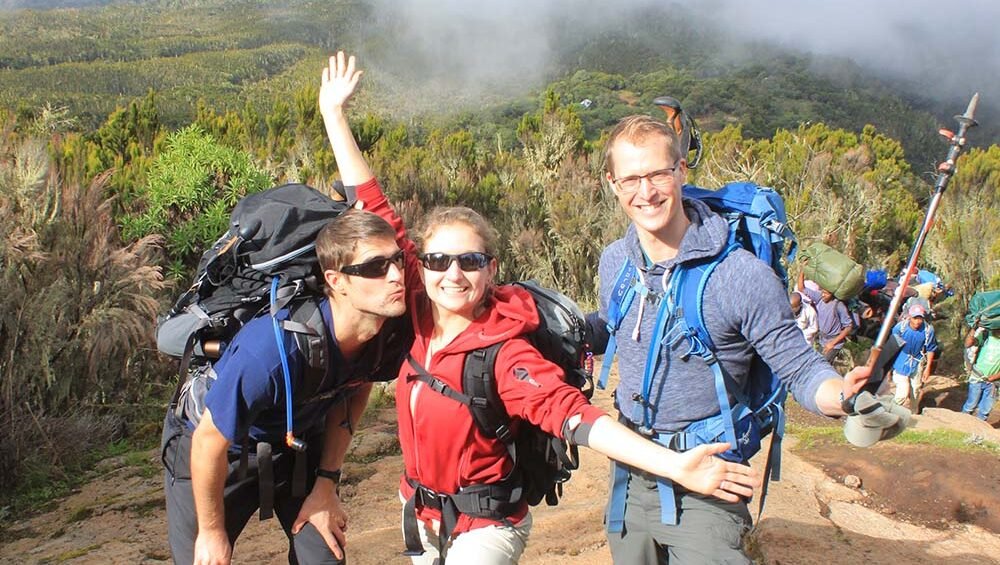
The Lemosho Route is the finest all-round route on Mount Kilimanjaro. It combines the mountain’s most spectacular scenery with the best acclimatisation profile of any standard route, consistently delivering the highest summit success rates. If you are climbing Kilimanjaro for the first time and want to maximise your chances of standing on Uhuru Peak, the 8-day Lemosho Route is the single best choice.
This guide covers everything you need to know about the Lemosho Route — the full day-by-day 8-day itinerary, camp elevations, daily distances, terrain, difficulty, what to expect on summit night, and how Serac Adventure runs the route from our base in Moshi.
| Lemosho Route at a glance |
| Starting gate: Londorossi Gate (2,360m / 7,740ft) — western approach |
| Exit gate: Mweka Gate (1,640m / 5,380ft) — southern descent |
| Total distance: approximately 70km (43 miles) |
| Duration: 8 days (7-day option available but not recommended) |
| Highest point: Uhuru Peak, 5,895m (19,341ft) |
| Summit success rate (8-day): 90–95% with a reputable operator |
| Difficulty: moderate to challenging — no technical climbing required |
| Serac Adventure price from: $1,900 per person (group rate) |
Why choose the Lemosho Route?
1. The best acclimatisation profile on Kilimanjaro
The Lemosho Route’s 8-day itinerary gives your body more time to adapt to altitude than any other standard route. The approach from the west is gradual and remote, and the critical acclimatisation move on Day 4 — ascending to Lava Tower (4,630m) before dropping to Barranco Camp (3,976m) — is the mountain’s best built-in acclimatisation strategy. More time at moderate altitude means more red blood cell production, better oxygen delivery, and a significantly higher summit success rate.
2. The most scenic route on the mountain
The Lemosho Route passes through more of Kilimanjaro’s terrain variety than any other trail. Starting in dense montane rainforest, you cross the sweeping Shira Plateau — one of the highest plateaus on Earth and the remnant of Kilimanjaro’s third volcanic peak — before traversing the dramatic Southern Circuit and ascending via Barafu Camp to the summit. The Barranco Valley and the iconic Barranco Wall scramble on Day 5 are among the most exhilarating sections of any Kilimanjaro route.
3. Less crowded than Machame
The Lemosho Route starts at a different gate than Machame, meaning the first two days are notably quieter. The routes merge near Lava Tower on Day 4, but the initial western approach gives Lemosho a more remote, wilderness feel that many experienced trekkers greatly prefer.
4. The giant senecio forest
One of Lemosho’s most distinctive features is the remarkable high-altitude giant senecio (Dendrosenecio kilimanjari) forest on the approach to the Shira Plateau. These extraordinary alien-looking tree groundsels, found only on Kilimanjaro, create a landscape unlike anything else on Earth.
Lemosho Route 8-day itinerary — day by day
The following itinerary is the standard 8-day Lemosho Route as operated by Serac Adventure. All elevations are approximate and vary slightly by precise campsite location.
| Day 1 Rainforest | Start: Londorossi Gate (2,360m) End: Mti Mkubwa / Big Tree Camp (2,750m) Distance: ~7km Hiking time: 3–4 hours Habitat: Rainforest Drive 4 hours from Moshi to Londorossi Gate for park registration, then continue by vehicle to the Lemosho trailhead. Begin hiking through pristine montane rainforest — mossy, green, and frequently misty. Look out for colobus monkeys and unique forest birds. A gentle introduction day ending at the atmospheric Big Tree Camp, named for the enormous trees that surround it. |
| Day 2 Moorland | Start: Mti Mkubwa Camp (2,750m) End: Shira 1 Camp (3,505m) Distance: ~8km Hiking time: 4–6 hours Habitat: Forest to moorland Emerge from the rainforest into open heathland and moorland, passing through giant heather shrubs and volcanic rock draped with lichen and old man’s beard. First clear views of Kibo — Kilimanjaro’s central peak — appear as you crest the ridge. Camp at Shira 1 on the edge of the Shira Plateau with sweeping views east toward the summit. |
| Day 3 Shira Plateau | Start: Shira 1 Camp (3,505m) End: Shira 2 / Cathedral Camp (3,872m) Distance: ~9km Hiking time: 5–7 hours Habitat: Moorland / high plateau A full crossing of the extraordinary Shira Plateau — one of the highest and most dramatic plateaus on Earth, formed from the collapsed remains of Kilimanjaro’s ancient Shira volcano. The walk is relatively gentle in terms of gradient but high in elevation. An optional acclimatisation hike to Cathedral Peak (3,872m) is included, providing outstanding panoramic views and an important altitude stimulus. Camp at Shira 2 with Kibo directly ahead. |
| Day 4 Acclimatisation | Start: Shira 2 Camp (3,872m) End: Barranco Camp (3,976m) via Lava Tower (4,630m) Distance: ~11km Hiking time: 6–8 hours Habitat: Alpine desert The most important acclimatisation day on the entire route. Trek up to the dramatic Lava Tower (4,630m) — a towering volcanic plug that marks the first day above 4,000m — before descending to Barranco Camp for the night. This ‘climb high, sleep low’ strategy is the key to the Lemosho Route’s high success rate. Despite ending at almost the same elevation as you started, your body has been exposed to a significantly higher altitude and begins producing more red blood cells overnight. |
| Day 5 Barranco Wall | Start: Barranco Camp (3,976m) End: Karanga Camp (4,035m) Distance: ~5km Hiking time: 4–5 hours Habitat: Alpine desert The day begins with the iconic Barranco Wall — a 257-metre scramble up a dramatic rock face that looks terrifying in photographs but is not a technical climb. Your guides assist at all key points and most climbers find it the most thrilling part of the entire trek. After the wall, traverse the southern face of Kibo through a series of ridges and valleys to the intimate Karanga Camp. Shorter day by distance but demanding. |
| Day 6 High camp | Start: Karanga Camp (4,035m) End: Barafu Camp (4,673m) Distance: ~5km Hiking time: 3–4 hours Habitat: Alpine desert / lunar landscape A morning hike across bare volcanic scree to Barafu Camp — the launch pad for the summit. Arrive by early afternoon, eat a hot lunch, rest and sleep as much as possible. Your guide will brief you on the summit night plan, gear check, and departure time. Summit night begins at midnight or 1am. This afternoon rest is critical — use it. |
| Day 7 Summit day | Start: Barafu Camp (4,673m) End: Uhuru Peak (5,895m) then Mweka Camp (3,100m) Distance: ~15km total Hiking time: 5–7 hrs ascent + 4–5 hrs descent Habitat: Arctic zone The hardest and most rewarding day. Depart at midnight in cold darkness, climbing steadily through loose volcanic scree toward Stella Point on the crater rim (5,756m). Above Stella Point, the terrain levels as you traverse the crater rim to Uhuru Peak — Africa’s highest point. Celebrate your summit before beginning the long descent all the way down to Mweka Camp through the moorland zone. A long, physically demanding day. |
| Day 8 Descent | Start: Mweka Camp (3,100m) End: Mweka Gate (1,640m) then Moshi Distance: ~10km Hiking time: 3–4 hours Habitat: Rainforest Final descent through the rainforest to Mweka Gate, where summit certificates are presented. Your legs will know they have descended 4,253 metres over two days. Meet your vehicle at the gate and transfer back to your hotel in Moshi — where a hot shower, a cold beer, and a proper bed are waiting. |
Elevation profile summary
| Day | Start camp | End camp | End elevation | Elevation change |
| Day 1 | Londorossi Gate | Mti Mkubwa (Big Tree) Camp | 2,750m | +390m |
| Day 2 | Mti Mkubwa Camp | Shira 1 Camp | 3,505m | +755m |
| Day 3 | Shira 1 Camp | Shira 2 / Cathedral Camp | 3,872m | +367m |
| Day 4 | Shira 2 Camp | Barranco Camp (via Lava Tower 4,630m) | 3,976m | High point +758m / net +104m |
| Day 5 | Barranco Camp | Karanga Camp | 4,035m | +59m (undulating) |
| Day 6 | Karanga Camp | Barafu Camp | 4,673m | +638m |
| Day 7 | Barafu Camp | Uhuru Peak then Mweka Camp | 3,100m | +1,222m / -1,795m |
| Day 8 | Mweka Camp | Mweka Gate (drive to Moshi) | 1,640m | -1,460m |
Difficulty and fitness
The Lemosho Route is rated moderate to challenging. No technical mountaineering skills are required — there are no ropes, harnesses, crampons, or ice axes. The Barranco Wall scramble on Day 5 involves hands-on rock scrambling but is not technical climbing and is assisted by your guides.
The primary physical demands are:
- Cardiovascular fitness for sustained daily hiking at altitude (3–8 hours per day)
- Leg strength for the steep ascent to Lava Tower and the Barranco Wall scramble
- Mental endurance on summit night — a 5–7 hour ascent in total darkness and cold
- Recovery capacity for the long summit-to-camp descent on Day 7
| How to train for the Lemosho Route Walk with a loaded daypack on uneven terrain for 3–4 hours, 2–3 times per week for at least 8 weeks before your climb. Include stair climbing, hill walking, or treadmill incline training to build leg strength. If possible, do at least one overnight hike at moderate elevation (2,000–3,000m) before Kilimanjaro. Cardio base (running, cycling, swimming) is helpful but stair/hill training is more directly relevant. |
Lemosho vs Machame: key differences
| Factor | Lemosho (8 days) | Machame (7 days) |
| Starting gate | Londorossi Gate (west) | Machame Gate (south-west) |
| Total distance | ~70km | ~62km |
| Days on mountain | 8 (standard) | 7 (standard) |
| Acclimatisation | Best on Kilimanjaro | Very good |
| Summit success rate | 90–95% | 82–87% |
| Crowds | Lower (first 2 days) | Higher throughout |
| Scenery | More varied, Shira Plateau | Dramatic, great views |
| Serac Adventure price from | $1,900 pp | $1,700 pp |
| Best for | First-timers, max success | Adventurous trekkers, budget |
What’s included in Serac Adventure’s Lemosho package
- All KINAPA national park fees and camping fees
- Experienced KINAPA-certified lead guide and assistant guide(s)
- Dedicated porter team — minimum 1.5 porters per climber
- Mountain cook with three hot meals per day plus snacks and hot drinks
- All camping equipment: sleeping tents, dining tent, toilet tent, sleeping mats, tables and chairs
- Safety equipment: pulse oximeters, supplemental oxygen, first aid kit
- Airport and hotel transfers from Moshi or Arusha
- Pre-climb gear check and briefing at our Moshi office
- Summit certificate on descent
- 24/7 WhatsApp support before and during your climb
Not included: personal trekking gear, international flights, travel insurance, crew tips ($250–$350 recommended).
Frequently asked questions: Lemosho Route
Is the Lemosho Route suitable for beginners?
Yes — it is actually our top recommendation for first-time Kilimanjaro climbers specifically because the 8-day itinerary provides the best acclimatisation and the highest chance of a successful, safe summit. You do not need any previous mountaineering or high-altitude experience.
How cold does it get on the Lemosho Route?
Temperature varies enormously by altitude. At lower camps (Shira 1–2), night temperatures are around 0°C to -5°C. At Barafu Camp on summit night, temperatures drop to -10°C to -20°C with wind chill. See our Kilimanjaro packing list for the full gear guide including summit night preparation.
Can I do the Lemosho Route in 7 days?
Yes — a 7-day Lemosho option exists, combining Days 3 and 4 into a single longer day. We offer it but do not recommend it. The 8-day itinerary’s extra acclimatisation day has a measurable impact on summit success rates and safety. If budget is a concern, the cost difference between 7 and 8 days is modest compared to the benefit.
When is the best time to do the Lemosho Route?
The Lemosho Route is best from January–early March and June–October, during Tanzania’s two dry seasons. July and August offer the clearest skies. January and February are excellent with fewer crowds and slightly warmer summit nights. See our best time to climb Kilimanjaro guide for a complete month-by-month breakdown.
| Book the Lemosho Route with Serac Adventure 8-day Lemosho packages from $1,900 per person — KINAPA-licensed, local Moshi operator. All park fees, guides, porters, meals, camping equipment, and transfers included. Contact us: +255 785 790 460 (WhatsApp) | info@seracadventure.com |