What you pack for Kilimanjaro is one of the most important decisions you will make before your climb. The mountain takes you through five entirely different climate zones in a matter of days — from humid equatorial rainforest at the base to a freezing arctic summit at 5,895 metres. Pack wrong and you risk cold, wet, blistered, and an abandoned summit bid. Pack right and your gear becomes invisible — just you, the mountain, and the trail ahead.
This packing list has been compiled by the Serac Adventure guide team in Moshi. We have helped hundreds of climbers prepare for Kilimanjaro and we know exactly what separates a comfortable, confident ascent from a miserable one. Use this list as your definitive reference.
| Kilimanjaro’s five climate zones — why layering is everything |
| Zone 1 — Cultivation / bushland (800–1,800m): Warm and humid. 21–27°C. T-shirt weather. |
| Zone 2 — Rainforest (1,800–2,800m): Lush, misty, frequently wet. 12–15°C. |
| Zone 3 — Heath & moorland (2,800–4,000m): Cooler, windier, increasingly dry. 5–10°C. |
| Zone 4 — Alpine desert (4,000–5,000m): Cold nights, warm days, dramatic swings. -5°C to +15°C. |
| Zone 5 — Arctic summit zone (5,000–5,895m): Sub-zero. Wind chill can make it feel -20°C or colder. |
The two-bag system: duffel bag and daypack
Every Kilimanjaro climber carries two bags. Understanding the difference is essential before you start packing.
Your porter duffel bag (70–90 litres)
This is carried by your assigned porter between camps. You will not have access to it during the day’s hike — only at camp each evening and morning. It must be a soft-sided, wheeless duffel bag. Hard suitcases and wheeled luggage are not suitable for the mountain.
- Weight limit: Your duffel must not exceed 15 kg (33 lbs) including the bag itself. This is strictly enforced at park gates to protect porter welfare. Serac Adventure weighs all bags before the gate.
- What goes in it: Sleeping bag, extra clothing layers, toiletries, camp shoes, snacks, and anything you do not need during the day.
Your daypack (25–35 litres)
This is what you carry yourself every day on the trail. It should be comfortable, well-fitted, and light.
- Water bottles or hydration bladder (at least 3 litres capacity)
- Snacks for the day’s hike
- Rain jacket and warm layer (accessible — weather changes fast)
- Camera, phone, and power bank
- Sunscreen, lip balm, sunglasses
- Personal first aid items and medications
- Headlamp with spare batteries (critical for summit night)
Clothing: the complete layering system
The golden rule on Kilimanjaro is layers. You need to be able to add and remove clothing easily as temperatures shift throughout the day and as you gain altitude. Never rely on a single heavy jacket.
Base layers (next to skin)
- Moisture-wicking base layer tops (x3): Merino wool or synthetic — never cotton. Cotton holds moisture and becomes dangerously cold when wet. Bring one for each day at higher camps.
- Moisture-wicking base layer bottoms (x2): Thermal leggings for cold mornings and camp. Merino wool preferred for warmth and odour resistance.
- Hiking socks (x6–8 pairs): Merino wool hiking socks. More socks than you think you need — wet feet on summit night are a summit-ender.
- Liner socks (x3 pairs): Thin liner socks worn under hiking socks reduce friction and prevent blisters.
- Thermal underwear: For sleeping and summit night. Bring a dedicated thermal set you keep dry and only wear at high altitude.
Mid layers (insulation)
- Fleece jacket (x1): Medium-weight fleece for evenings at camp and cold mornings. Incredibly versatile and packs small.
- Down or synthetic insulated jacket (x1): Your primary warmth layer for the summit. Down is lighter and warmer when dry — synthetic performs better if wet. Either is fine on Kilimanjaro if kept dry in a dry bag.
- Fleece or softshell trousers (x1): For cold evenings, high camps, and summit night. Worn over your base layers.
Outer shell (waterproof and windproof)
- Waterproof jacket with hood (x1 — essential): Your single most important piece of clothing. Must be fully waterproof (not just water-resistant) and windproof. Needed in the rainforest zone and on the summit. Gore-Tex or similar membrane recommended.
- Waterproof overtrousers (x1): Worn over your hiking trousers during rain and on summit night. Must fit comfortably over your base and mid layers.
Trekking trousers and shirts
- Trekking trousers (x2): Zip-off convertible trousers are ideal — warm on cold days, shorts for the lower rainforest zone. Quick-drying synthetic material.
- Hiking shirts (x3): Long-sleeve moisture-wicking shirts. Sun protection rating (UPF 30+) is a bonus.
Head and hands
- Warm beanie / thermal hat (x1): Worn at high camps and summit night. Essential — significant body heat is lost through the head.
- Sun hat with brim (x1): For the lower slopes and sunny days. Protects against intense equatorial UV radiation.
- Balaclava or neck gaiter / buff (x1): Covers face and neck on summit night. Can mean the difference between comfort and frostbite.
- Lightweight liner gloves (x1 pair): For cold mornings and the upper mountain.
- Thick insulated or ski gloves / mittens (x1 pair): For summit night. Your hands will be exposed on the approach to Uhuru Peak in sub-zero wind chill.
| Summit night clothing — what to have ready Summit night is the coldest, hardest part of the climb. Temperatures at the crater rim can fall to -15°C or below with wind chill. Layer up in this order: thermal base layer, fleece mid-layer, insulated down jacket, waterproof shell outer. Legs: thermal base + fleece trousers + waterproof overtrousers. Hands: liner gloves inside thick insulated mittens. Face: balaclava under beanie. Only eyes and nose exposed. Pack your summit night outfit separately at the top of your duffel so it is ready to put on at midnight. |
Footwear
Trekking boots (most important item on the list)
Your boots are your single most critical piece of gear on Kilimanjaro. Get this wrong and no amount of good clothing will save your summit.
- Ankle-height or mid-cut waterproof boots (x1 pair — essential): Must be fully waterproof, broken in before the climb (at least 80–100 km of walking), and provide good ankle support. Gore-Tex lined preferred. Popular choices: Scarpa Zodiac, La Sportiva TX5, Salomon Quest, Lowa Renegade.
- Trail runners or camp shoes (x1 pair): Lightweight shoes for walking around camp in the evenings. Your feet will thank you for getting out of heavy boots at the end of each day.
- Gaiters (x1 pair): Keep scree, snow, and mud out of your boots on the upper mountain. Particularly important on Kilimanjaro’s loose volcanic terrain above 4,000m.
| Never climb Kilimanjaro in new boots Blisters are the leading cause of abandoned summit attempts that have nothing to do with altitude. Break in your boots completely before flying to Tanzania. Wear them on long walks, hikes, and day trips. If you develop a blister on day two, it will be an open wound by summit night. Prevention is everything. |
Sleeping gear
- Sleeping bag rated to -10°C to -15°C (x1 — essential): Nights at Barafu Camp (4,673m) and on summit night can drop to -15°C or below. Do not bring a three-season bag. A four-season or expedition-rated sleeping bag is required. Can be rented in Moshi if you do not own one.
- Sleeping mat / liner (optional): Serac Adventure provides sleeping mats at all camps. A silk or fleece liner adds warmth inside your sleeping bag.
Trekking poles
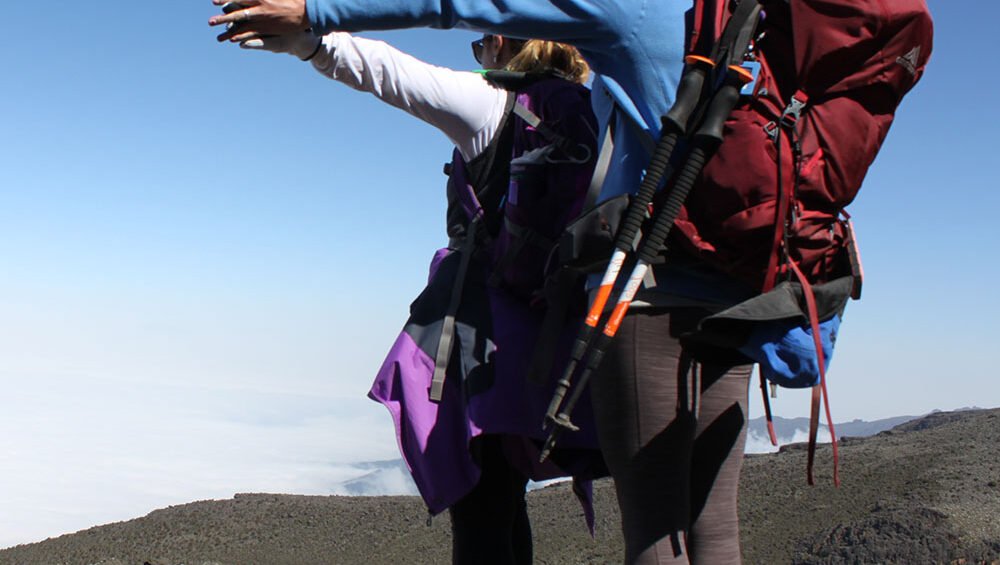
Trekking poles are strongly recommended for Kilimanjaro — particularly on the steep descent from the summit, which is tough on knees, and on the loose Barafu scree. They significantly reduce fatigue and improve stability.
- Collapsible trekking poles with interchangeable tips (x1 pair). Carbon fibre is lighter; aluminium is more durable and less expensive.
- Can be rented from gear shops in Moshi or Arusha if you do not own a pair.
Hydration and nutrition
- Water bottles (x2, 1 litre each) or a 3-litre hydration bladder: You should be drinking 3–4 litres of water per day on Kilimanjaro. Insulated bottles prevent water from freezing at high altitude.
- Water purification tablets or a SteriPen: Camp water is boiled by your cook team, but purification tablets are useful as backup.
- High-energy snacks: Trail mix, energy bars, chocolate, dried fruit, and nuts for each day’s hike. Your appetite often decreases at altitude — eat anyway.
- Electrolyte tablets or powder: Add to water to replace lost salts and reduce cramping. Particularly useful on summit night.
Sun protection
- High-SPF sunscreen (SPF 50+) — reapply every 2 hours above 3,000m where UV radiation is intense
- Glacier sunglasses or goggles with UV400 protection — essential on the upper snowfields
- SPF lip balm — lips crack badly at altitude in the dry air
Health and medications
Consult your doctor before departure about all medications. The following are commonly recommended:
- Acetazolamide (Diamox) — prescription required: The most widely used medication for altitude sickness prevention on Kilimanjaro. Speeds up acclimatisation by increasing breathing rate. Typical dose: 125–250mg twice daily, starting 1–2 days before the climb. Side effects include increased urination and tingling in the hands and feet — both normal.
- Ibuprofen (600mg): Over-the-counter option that studies show helps reduce AMS symptoms. Some climbers use it instead of or alongside Diamox.
- Paracetamol / aspirin: For headaches — extremely common at altitude.
- Blister plasters (Compeed or similar): Treat blisters early before they become a serious problem.
- Antifungal cream and foot powder: For long days in boots.
- Lip balm and skin moisturiser: Cold, dry air at altitude strips moisture rapidly.
- Throat lozenges: The cold dry air causes sore throats — common on Kilimanjaro.
- Anti-diarrhoea tablets (Imodium): Useful to have on hand in case of stomach upset.
Electronics and power
- Headlamp with spare batteries (x1 — essential). Summit night starts at midnight in total darkness. A headlamp is not optional.
- Spare batteries or a rechargeable headlamp (cold drains batteries fast at altitude)
- Power bank / portable charger (x1 — high capacity recommended)
- Camera with spare memory card and battery — cold kills camera batteries
- Phone with offline maps downloaded (Maps.me or Google Maps offline)
- Universal travel adapter (Tanzania uses Type G / UK-style plugs)
Documents and essentials
- Passport (valid for 6+ months from entry date)
- Tanzania eVisa approval printout
- Travel insurance documents with emergency contact and policy number
- Emergency contact details and blood type written on a card in your daypack
- Cash in USD (for tips, gear rentals in Moshi, and incidentals)
What can be rented in Moshi
Do not panic if you are missing items — good quality rental gear is available in Moshi and from Serac Adventure. Commonly rented items:
| Gear available to rent in Moshi |
| Sleeping bag (-15°C rated) — approx. $10–20 for the duration of the climb |
| Trekking poles — approx. $5–10 |
| Gaiters — approx. $5 |
| Down jacket — approx. $10–20 |
| Waterproof jacket and overtrousers — approx. $10–15 |
| Note: boots cannot be reliably rented — bring your own broken-in pair. |
What NOT to bring
- Cotton clothing of any kind (jeans, cotton T-shirts, cotton socks) — cotton kills at altitude by holding moisture and chilling rapidly
- Heavy books or non-essential items — every extra kilogram costs you energy on the ascent
- Hard-sided or wheeled suitcases — impractical for porters and not allowed
- Valuable jewellery or expensive watches — leave these at home or in your hotel safe in Moshi
- Alcohol — strictly not recommended at altitude (dehydrating and impairs acclimatisation)
| Serac Adventure packing tip When you book your Kilimanjaro climb with Serac Adventure, we send every client a personalised packing list checklist and gear check reminder two weeks before departure. We also offer a free pre-climb gear check at our Moshi office — bring everything you plan to bring on the mountain and our guides will tell you honestly what you need, what you can leave behind, and what you can rent locally. Contact us at +255 785 790 460 or info@seracadventure.com. |